What to Wear to Brunch When the Patio Is 85 and Inside Is 65
Quick Answer: Dress for the hotter of the two spaces and carry one thin, tightly knit layer — not a structured jacket. A fine merino or cotton cardigan roughly the weight of a t-shirt closes a 20-degree gap because it traps air without adding bulk, and it folds into a bag the size of a paperback. Bare arms plus one thin layer beats short sleeves plus nothing, every time.
You got seated on the patio at 11am and it was 85 with full sun. By noon the table opened up inside and the AC is running like it is July. Now you are cold in the same outfit that had you sweating 20 minutes ago.
This is a solvable problem, and the solution is smaller than the jacket you have been carrying.

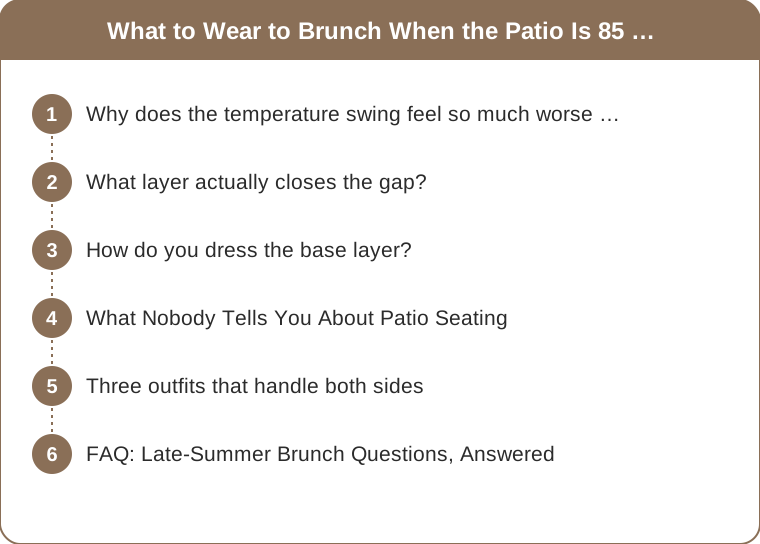
Why does the temperature swing feel so much worse than 20 degrees?
Because you are not just moving between two temperatures — you are moving between two airflow conditions.
On the patio you have moving air and radiant sun. Inside you have a vent blowing conditioned air, often directly down onto a table. Moving cold air pulls heat off skin roughly three times faster than still air at the same temperature. A 65-degree room with a vent overhead feels like the high 50s on bare shoulders.
That is why people who dress for the average of the two spaces end up uncomfortable in both. The average is not a real place. You need a base that works at 85 and one add-on that works under a vent.
What layer actually closes the gap?
A thin, tightly knit layer. Weight matters less than knit density.
A fine-gauge merino cardigan at roughly 150 to 200 grams per square meter — about the weight of a good t-shirt — will hold you comfortably through a 20-degree drop. So will a tightly woven cotton or a silk-blend knit. All three trap a still layer of air against your skin, which is the entire mechanism.
A loose, open-weave linen cardigan does almost nothing under a vent, because the air moves straight through it. It looks like a solution and performs like decoration.
Skip the denim jacket for this specific job. It works, but it is 4 times the bulk for the same result, and you will end up holding it for 40 minutes.
How do you dress the base layer?
Dress for the hot side and leave the arms bare.
A sleeveless dress, a tank with a skirt, or a short-sleeve top in a breathable fabric. The goal is that you are comfortable at 85 with nothing added — because you will be sitting in that condition for the first stretch, and that is when photos happen.
Bare arms are also what makes the layer work. Skin plus a thin knit is warmer than a short sleeve plus the same knit, because the knit sits directly against skin and traps air there rather than over an already-damp cotton sleeve.
One fabric note for August: linen, cotton poplin, and lightweight tencel all move moisture. Rayon challis and thin polyester feel light in the store and cling the moment you sweat.

What Nobody Tells You About Patio Seating
The sun moves. A table that is shaded at 11am is in full sun by 12:30. If you are booking a two-hour brunch, assume you will be in direct sun for part of it, and pick a color accordingly — a black dress in August sun runs noticeably hotter than the same dress in white or a mid-tone.
Metal chairs are hot. A wrought-iron patio chair in full sun will be genuinely uncomfortable against bare thighs. A dress that reaches mid-thigh when seated solves a problem you did not know you had.
Heaters run in the shoulder season too. From about mid-September, many patios turn on overhead heaters, which reverses everything — now the patio is the warm side and inside is neutral. Same strategy, opposite direction.
Your bag is your closet. Choose a bag with roughly 8 to 10 inches of interior width and your cardigan lives there instead of on your lap. This is the detail that decides whether you actually bring the layer next time.
Three outfits that handle both sides
The linen dress version. Sleeveless midi in linen or a linen blend, flat sandals, fine merino cardigan in the bag. Works from 85 on the sidewalk down to 62 under a vent.
The separates version. Cotton tank, high-waisted wide-leg trouser in a light weave, thin knit tied at the shoulders. The trouser handles the metal-chair problem and reads more polished than shorts if brunch turns into an afternoon.
The dress-and-button-down version. Slip dress with a lightweight cotton button-down worn open over it. The shirt is the layer, so nothing extra rides in your bag — and buttoning it once inside gives you real coverage without changing the outfit.
All three follow the same structure: hot-side base, one thin dense layer, nothing structured.
FAQ: Late-Summer Brunch Questions, Answered
Can I just bring a denim jacket?
You can, and it works thermally. But it is bulky enough that most people leave it on a chair back and forget the point. A thin knit gets used because it is not a burden.
What about a scarf instead of a cardigan?
A large silk or cotton scarf covers shoulders under a vent and takes up almost no bag space. It handles about a 10-degree gap, not 20 — good for a mild room, not for aggressive AC.
Are shorts fine for brunch?
Tailored shorts in a woven fabric read fine almost anywhere brunch happens. Athletic or drawstring shorts read differently. If in doubt, a light trouser costs you almost nothing in heat and removes the question entirely.
TL;DR:
- Dress for the hot side — bare arms, breathable base — and carry one layer rather than splitting the difference.
- The layer that works is thin and tightly knit (fine merino, dense cotton), not loose and open.
- The indoor side feels colder than its temperature because of moving air from vents, which is why 20 degrees feels like 30.
- Sun moves across patios and metal chairs get hot; both are worth a thought when picking color and length.
Put a fine knit cardigan in the bag you actually carry and the whole problem disappears for the rest of the season. Come late September the patio heaters flip the equation, and the same cardigan still works.
Keep Reading
This article is for general styling and informational purposes only. Trends, sizing, availability and pricing may vary by brand and season.